By CroquetClaude · 5 min read
Lawn Care Through a Queensland Summer
How to keep a Queensland court fast and disease-free through the wet season's peak growth and peak fungal risk.
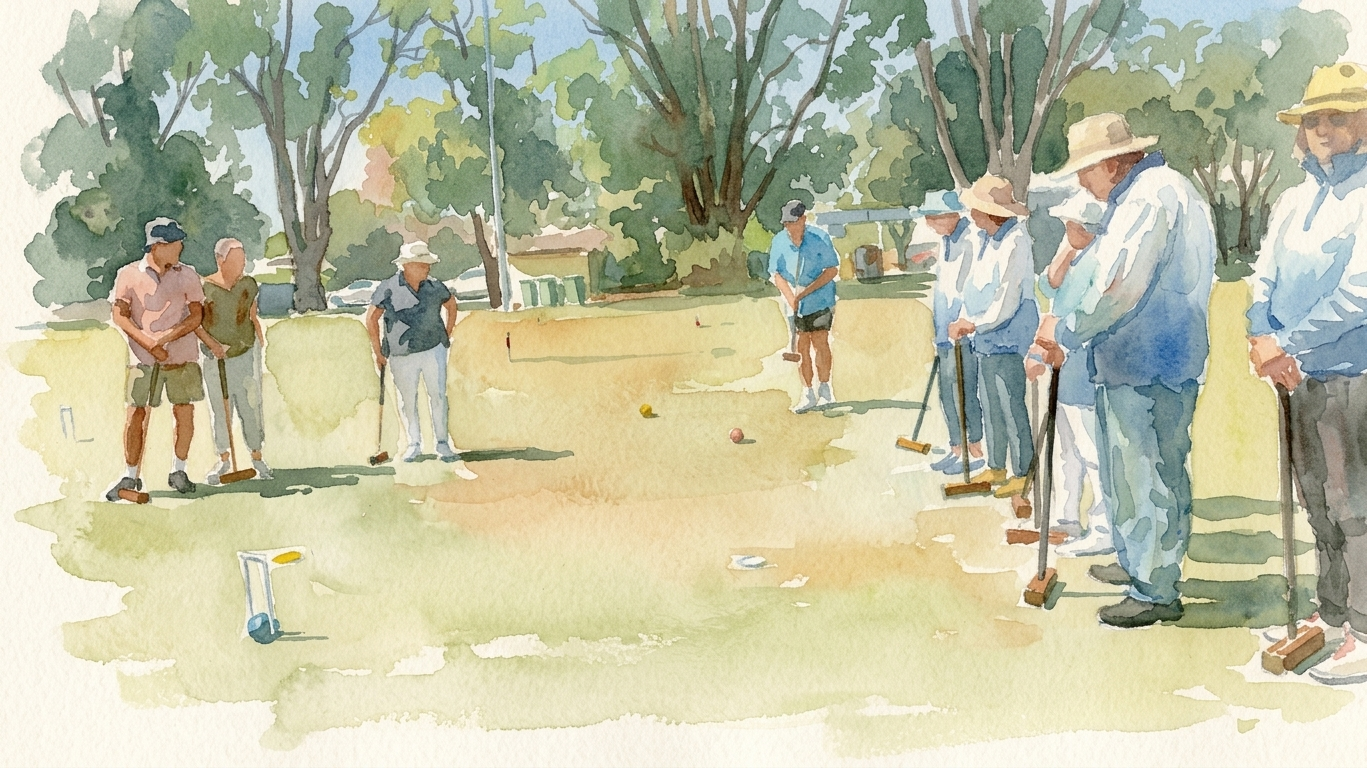
Queensland's wet season, roughly November through March, is the hardest stretch of the year for a croquet court. Warm nights, high humidity and heavy, irregular rainfall push growth to its peak at the same time disease pressure is at its worst. This page pulls together the watering, mowing and disease-prevention practices that matter most across those months.
The wet season challenge
Queensland has two distinct seasons that should drive court maintenance decisions. The wet season brings high humidity, warm nights, and irregular but often heavy rainfall. During this period, supplemental watering is often unnecessary, and the real challenge is managing too much water rather than too little. Growth also accelerates to its fastest point of the year, which means mowing has to keep pace or the court gets away from you.
Warm nights above 20°C combined with wet foliage overnight are exactly the conditions brown patch needs to establish. Penn State Extension's turfgrass disease guidance puts the trigger at night temperatures above 68°F (20°C) with daytime temperatures around 80°F, and notes that rain and saturated humidity speed the disease along further. A Queensland wet season delivers both most nights from November to March, which is why timing when you water matters as much as how much you use.
Watering through summer
Water in the early morning, ideally before 8am, and always within the 5am–10am morning window. Watering in the afternoon or evening leaves moisture sitting on the leaf surface overnight, and that overnight leaf wetness combined with warm nights is the primary trigger for brown patch and other fungal disease. The Queensland Government's own watering guidance recommends this same morning window for exactly this reason: water between 5am and 10am, because evening irrigation "can lead to fungus growth as leaves can remain wet overnight." Through the wet season, rainfall is often enough on its own: the job shifts from "how much to add" to checking that drainage is coping.
Where irrigation is still needed, deep and infrequent watering beats shallow daily watering. A good soak every two or three days encourages roots to grow downward; daily light watering keeps roots near the surface and more vulnerable to heat and drought stress later in the dry season.
Mowing through summer
During peak growing season (November through March), a competition court needs mowing two to three times a week to hold a competition height of 4–6mm. Training and general club play is manageable at 8–10mm, which copes with wear and recovers faster between sessions.
Vary the mowing direction with each pass: alternating between north–south and east–west passes every other mow stops the grass developing a grain in one direction, which affects ball roll and can create striping. Never mow wet grass: wet blades fold rather than cut cleanly, clippings clump and smother the surface, and mower wheels compact wet soil in a way that creates lasting drainage problems, a real risk in a season with frequent rain. Never take more than a third of the blade height off in a single cut, either. Turf Queensland's own mowing guidance calls anything more than that scalping, and warns it exposes the thatch layer or bare soil underneath, an easy trap after a fortnight nobody got to the mower.
Disease risk and prevention
Queensland's disease risk calendar runs roughly the opposite of England's: the highest-risk period is the wet summer (November to March), not autumn, and November to April needs active preventive management.
Brown patch is the most common problem through summer. It shows as roughly circular patches of discoloured grass, tan or light brown at the centre with a darker ring at the active margin. Morning watering, rather than evening, is the single most effective cultural control.
Fairy ring can also show up through summer, appearing as a ring of lush dark green grass, a ring of dead or stunted grass, or mushrooms in a ring pattern. Keeping thatch under control through regular scarification is the most effective prevention.
Pythium develops in persistently waterlogged areas, low spots, areas near downpipes, or courts with drainage problems, and causes rapid collapse of grass in a greasy-looking pattern. Improving drainage is the fix; fungicide without correcting drainage only gives temporary relief.
| Period | Frequency | Active ingredients to consider |
|---|---|---|
| November–April (wet season) | Monthly | Azoxystrobin, propiconazole, flutolanil |
| May–October (dry season) | Quarterly | Azoxystrobin (as required) |
| After extended wet weather | As triggered | Azoxystrobin or propiconazole |
Use APVMA-registered products only, and check current labels before purchasing, as registrations change. Some fungicide formulations are classed as restricted chemical products requiring a licensed agvet chemical user for application: check with your local sports turf supplier before assuming a product isn't restricted.
Month by month through summer
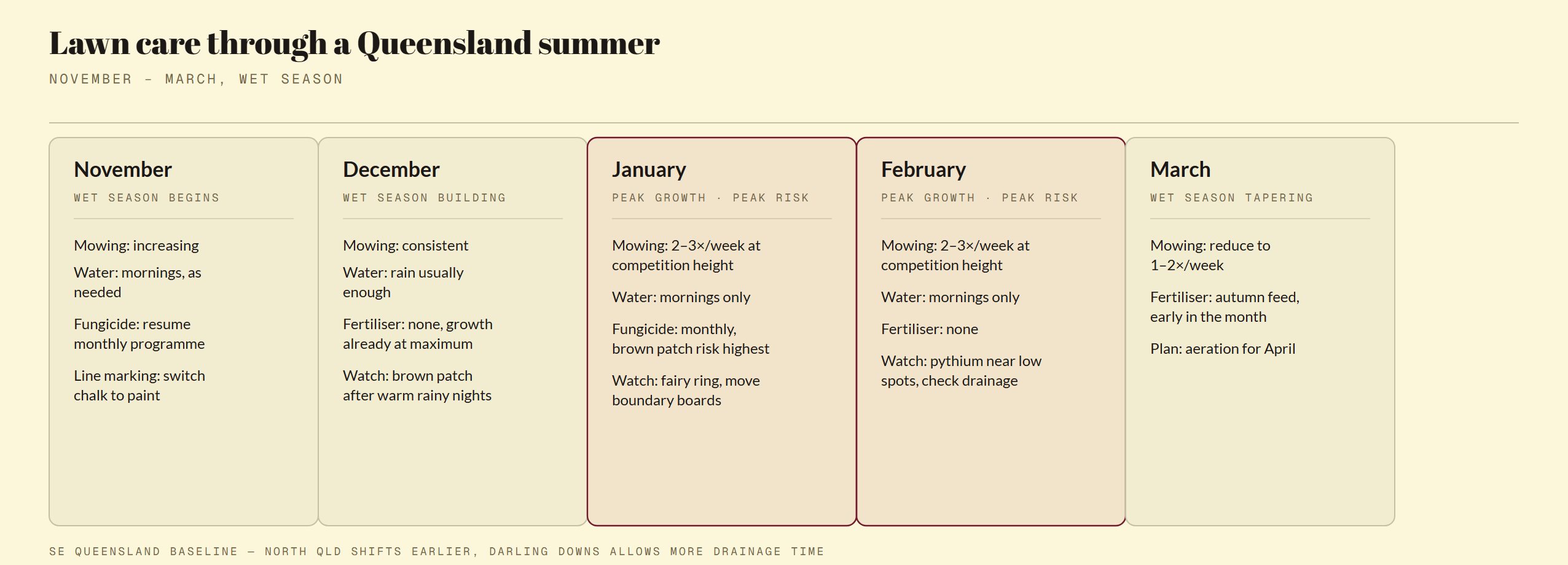
| Month | Season | Key tasks |
|---|---|---|
| November | Wet season begins | Humidity arrives and disease risk opens up. Resume monthly fungicide. Growth accelerating, so increase mowing frequency. Switch line marking from chalk to paint for wet season durability. |
| December | Wet season building | Mow consistently. Do not fertilise: growth is already at maximum. Monitor for brown patch after warm rainy nights. Confirm drainage is functioning. |
| January | Wet season, peak growth | Mow 2–3 times per week at competition height. Water mornings only (rain usually sufficient). Apply fungicide monthly: brown patch risk is highest. Inspect for fairy ring. Move boundary boards regularly to prevent wear grooves. |
| February | Wet season, peak growth | As January. Watch for pythium in any low spots or areas near downpipes. Inspect drainage. Do not fertilise. |
| March | Wet season tapering | Growth beginning to slow. Reduce mowing to 1–2 times per week. Apply autumn fertiliser early in the month. Plan the aeration programme for April. |
| April | Dry season begins | The monthly fungicide regime continues through April, completing the November–April prevention window. Begin the hollow tine aeration programme planned in March: high-traffic areas first, then top-dress the cores with fine sand. |
This calendar is based on South-East Queensland conditions. North Queensland clubs (Townsville, Cairns) should shift these tasks earlier and expect shorter or absent winter dormancy either side of summer. Darling Downs clubs on black soil should allow more time for drainage work through the wet season.
Last fact check: 23 September 2026