By CroquetClaude · 4 min read · First added 19 Nov 2026
Coring Explained
Coring punches holes in a court so air, water and roots can get into packed-down soil, between scarifying and the sand.
Coring punches holes in a court so air, water and roots can get into packed-down soil. It is done during the spring renovation, after scarifying and before the sand goes on.
This is one of five guides on court renovation. For how all the steps fit together in one closure, read Renovating Your Courts first.
What coring is and why courts need it
Coring, also called aeration, means making holes in the soil so that air, water and roots can get in.
The problem it fixes is compaction. Feet, mowers and rain pack the soil down. Roots then stay shallow, water sits on top or runs off, and the grass thins out in the busy lanes. Coring also breaks into the thatch layer.
A simple check: push a screwdriver into the court. If it will not go in, the soil is compacted, as both the turf growers' network Lawn Solutions Australia and Sydney sports-field contractor Bloom Maintenance point out.
Hollow tines and solid tines
The spikes on the machine are called tines. There are two kinds, and tine machine maker Redexim and Bloom Maintenance describe them like this.
| Hollow tines | Solid tines | |
|---|---|---|
| What they do | Hollow tubes pull out plugs of soil and thatch | Solid spikes punch holes and take nothing out |
| How hard on the court | More disruptive, longer recovery | Quicker and gentler |
| How often | Usually once or twice a year | Can be done more often in the growing season |
Hollow tines work much better on deep compaction and thatch. Solid tines are less effective, and over time they can make badly compacted soil worse.
The machine
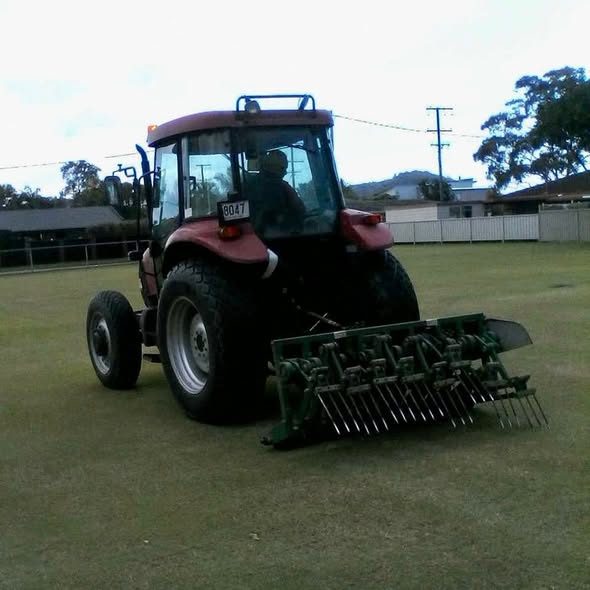
The machine is either towed by a small tractor or is a walk-behind one. A row of tubes or spikes drives down into the court and lifts out again. Bloom Maintenance gives typical holes of 10 to 20mm across and 75 to 150mm deep, depending on the machine. The Range Maleny checked the aeration depth during its 2024 work.
Straight after
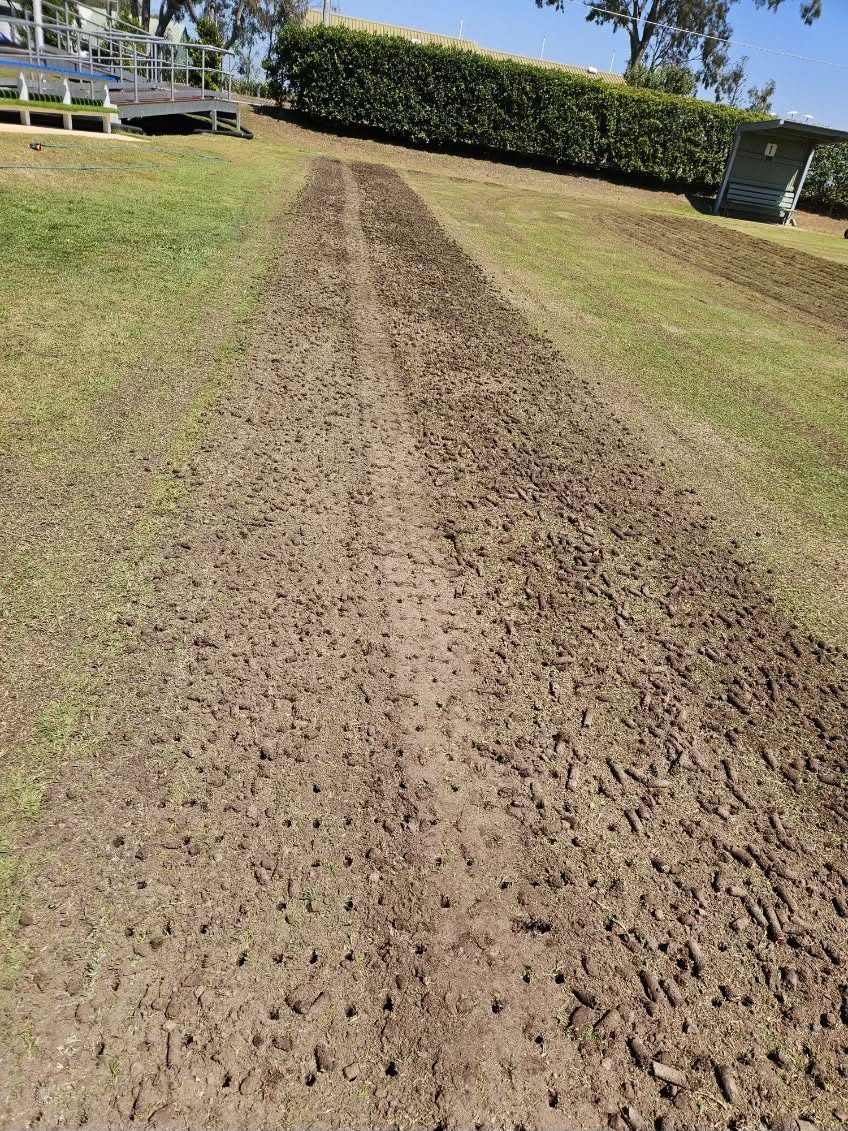
The court looks rough: small holes everywhere, plugs of soil lying on top, a churned sandy-brown surface and machine tracks. The holes are what the sand fills when the court is top-dressed.
The plugs
The plugs, or cores, are either broken up and dragged back into the surface, or swept off. Cores left to dry can be broken up with a stiff broom.
What coring cannot do
Coring does not fix humps and hollows. A UK croquet lawn guide in the Oxford Croquet archive says changing levels this way "is a slow process"; "you may, if fortunate, be able to effect a 1 inch change over 5 years". Levelling is its own step, covered in Top-dressing and levelling.
When
Coring is best done when the soil is moist, not very dry or very wet. Most Queensland clubs core in the spring or early-summer closure: first scarifying, then coring, then the sand. Eildon's 2026 closure notice lists "heavy scarifying, levelling, coring and topdressing", and its 2023 renovation plan included coring too. Bloom Maintenance says healthy couch can recover in about a fortnight, though that figure is for Sydney sports fields.
Some clubs also do a lighter hollow tine on the busiest areas in April and May, brushing fine sand into the holes. This is an extra, not a replacement for the spring work. See Getting the Lawn Through a Hot, Dry Summer.
Who does it
Usually a contractor, because of the machine. After the 2022 floods, Windsor's lawns were cored from 2 January 2023, with coring complete by 9 January. Top-dressing followed. At Caloundra, around the same time, courts 2 and 5 "have now been cored and scarified, and will be out of action for a couple of weeks".
Where this comes from
Comments
Ask a question or tell us what worked at your club. Replies show under your comment.