By CroquetClaude · 5 min read · First added 19 Nov 2026
Scarifying Explained
Scarifying rips dead grass out of a court so it plays faster and grows thicker, and in Queensland the recommended window is October to November.
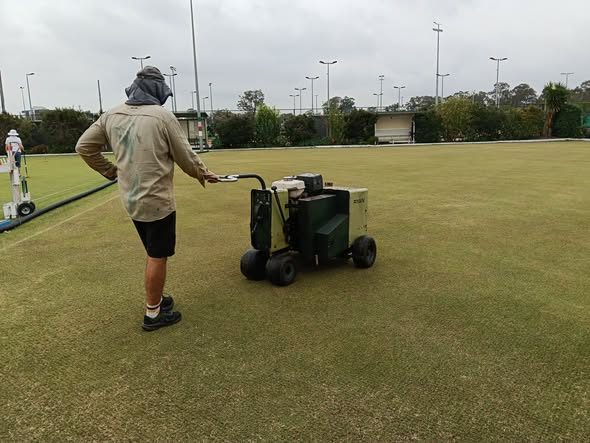
Scarifying rips dead grass out of a court so it plays faster and grows thicker. In Queensland the recommended window is October to November. The court looks rough for a few weeks, then recovers.
This guide is one of five on court renovation. For how all the steps fit together across the year, start with Renovating Your Courts.
What scarifying is
Scarifying means using a machine with blades to rake dead grass, called thatch, out of the court. You may also hear it called de-thatching or verticutting. People use these words loosely. A light verticut just skims the top. A full or deep scarify cuts below the surface.
Thatch is a spongy mat of dead stems, runners and roots that sits between the green leaf and the soil. Couch grass builds it up, and a little is fine. Too much traps water and food, so the surface goes soft and the ball runs slow.
Wynnum's story on why its groundsman scarifies puts the benefits plainly. Water gets into the soil more easily. Dead material comes out, giving new grass room to grow. Air, water and nutrients reach the roots. The grass spreads into bare patches and the lawn thickens.
The machine
A scarifier is either a walk-behind machine or a unit towed by a small tractor. It has rows of spinning upright blades that slice down into the turf. Hire centres and sports turf contractors supply them. It looks violent, because it is. It pulls out dead stems and runners and leaves furrows, and the thatch comes up in heaps that must be raked, swept or mown up.
Scalping comes first
Before scarifying, the court is mown far lower than normal, right down to the thatch, with the mower on its lowest setting. Couch copes because it regrows from its runners. Murdoch, a UK croquet club greenkeeper, wrote in 2004 that if you skip this step, clearing up after a deep scarify is "very hard work". Ask your greenkeeper or contractor what height suits your courts.
How much comes out
A lot. In December 2020, Toombul took 300kg off lawn 2 and 250kg off lawn 3. In late 2021, Eildon's greenkeeper Rino and volunteer helpers scarified in two directions and trailered away three loads of thatch and clippings. You will need a trailer or skip and somewhere to tip it.
What the court looks like straight after
Bare, sandy-brown and torn up, with rows of raked-up dead grass. As Wynnum's story says, "Although the lawns may look a little rough immediately after scarifying, this is all part of the process. With a little time and care, the grass should recover and become healthier, thicker and more resilient."
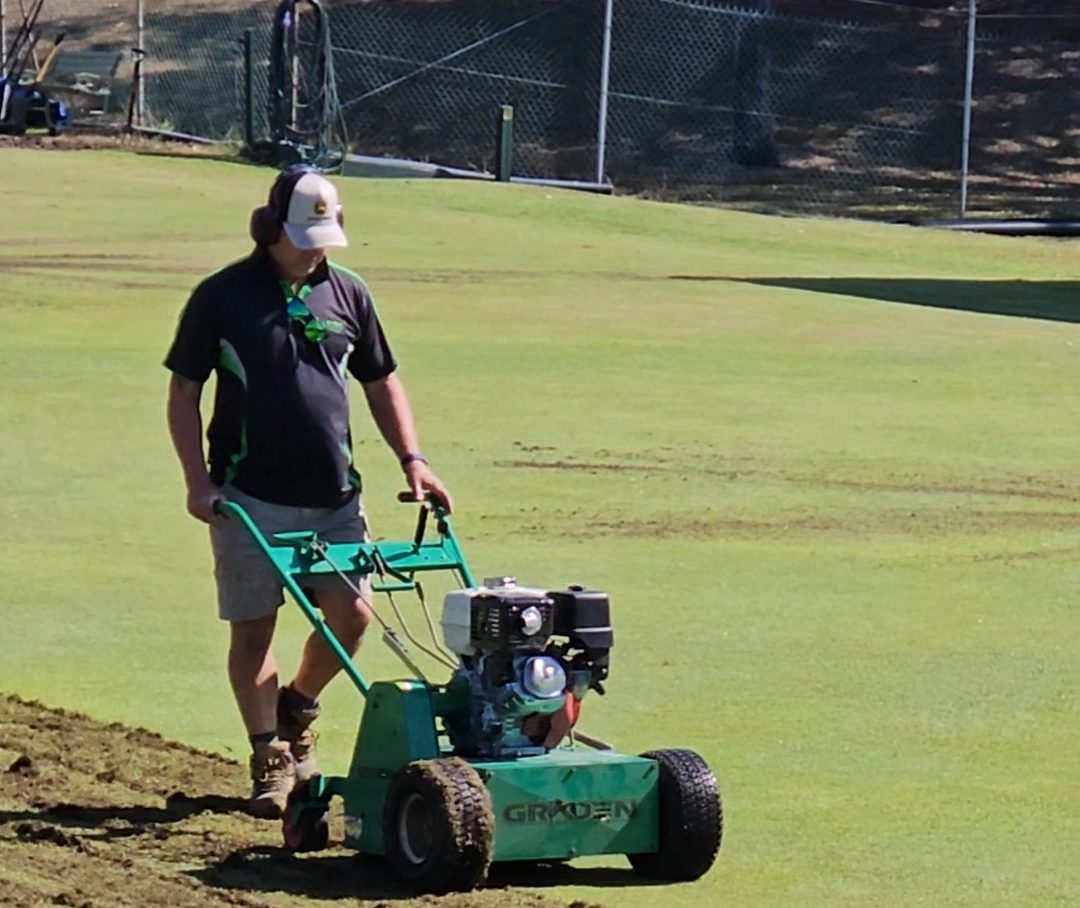
Closures vary. At Stephens in February 2021, courts 3 and 4 were expected to "be out of action for 3 or 4 weeks". Courts 1 and 2 were green and back in play three weeks after scarifying, wetting agent and fertiliser. After a volunteer scarify at Eildon in October 2025, the lawns stayed closed until Melbourne Cup Tuesday, 4 November.
When
In Queensland, the heavy scarify belongs in October to November, the window set out in Getting the Lawn Through a Hot, Dry Summer. The couch has recovered from winter, and wet-season fungus has not yet peaked. Lawn Solutions Australia advises waiting until the grass is growing strongly and has been mown a few times. Never scarify in winter dormancy or in mid-summer heat.
Most clubs in our records have scarified between September and January, though Stephens did it in February 2021. Wynnum began on 13 November 2024; Capricorn Coast members scarified in December 2025.
Who does it
Some clubs use volunteers: Windsor has a volunteer scarifying team, and Eildon and Capricorn Coast members did it in 2025. Others hire help. In 2026, Eildon had a professional lawn maintenance company do the "heavy scarifying". A sensible split is a contractor for the heavy yearly job and club volunteers for light verticutting during the year.
Cautions
The first three cautions come from one UK croquet greenkeeper, Murdoch, writing in 2004 about UK grass.
- No second scarify within about a fortnight. Murdoch found a normal scarify two weeks before a deep one was "too much surface disturbance in too short a time".
- No overlapping passes. Overlap can plough up the turf.
- Blades the right way round. When hired blades were fitted backwards one year at Murdoch's UK club, "most of the tungsten tips were knocked out" and left lying in the green.
- Never on a stressed or dormant lawn.
- Start on a light setting. Look at what comes up before going deeper.
Ask your greenkeeper or contractor how these apply to your couch courts.
Straight after
Water straight away after a heavy scarify, and give a light feed to help recovery. In a full renovation, the next step is coring, then sand.
Where this comes from
Comments
Ask a question or tell us what worked at your club. Replies show under your comment.